aubio
0.4.6 released
A new version of aubio, 0.4.6, is now available.
This version includes:
-
yinfast, a new version of the YIN pitch detection algorithm, that uses spectral convolution to compute the same results as the originalyin, but with a costO(N log(N)), making it much faster than the plain implementation (O(N^2)) -
Intel IPP optimisations (thanks to Eduard Mueller), available for Linux, MacOS, Windows, and Android
-
improved support for emscripten (thanks to Martin Hermant), which compiles the aubio library as a javascript module and lets you run aubio's algorithm directly from within a web-page.
0.4.6 also comes with several bug fixes and improvements.
Many thanks to Eduard Mueller (@emuell), Martin Hermant (@MartinHN), Hannes Fritz (@hztirf), Stuart Axon (@stuaxo), Jörg (@7heW4yne), ssj71 (@ssj71), Andreas Borg (@borg), Rob (@mlrobsmt) and everyone else for their valuable contributions and input.
Wed, 04 Oct 2017, 13:45. trackback - view/add comments
Analyzing songs online
When built with ffmpeg or libav, aubio can read most existing audio and video formats, including compressed and remote video streams. This feature lets you analyze directly audio streams from the web.
A powerful tool to do this is
youtube-dl, a python program which
downloads video and audio streams to your hard-drive. youtube-dl works not
only from youtube, but also from a large number of
sites.
Here is a quick tutorial to use aubio along with youtube-dl.
Wed, 04 Oct 2017, 12:34. trackback - view/add comments
0.4.5 released
A new version of aubio, 0.4.5, is available.
This version features:
- a new
aubiopython command line tool to extract information from sound files - improved default parameters for onset detection, using adaptive spectral whitening and compression
- support for libswresample
New options --miditap-note and --miditap-velo have been added to
aubioonset and aubiotrack to adjust the note and velocity of the midi note
emitted by onsets and beats.
0.4.5 also comes with a bunch of fixes, including improved documentation, build system fixes, and platform compatibility.
Many thanks to Martin Hermant (@MartinHM), Sebastian Böck (@superbock), Travis Seaver (@tseaver) and others for their help and contributions.
Mon, 10 Apr 2017, 15:02. trackback - view/add comments
0.4.4 released
A new version of aubio, 0.4.4, is available.
This version features a new log module that allows redirecting errors,
warnings, and other messages coming from libaubio. As usual, these messages are
printed to stderr or stdout by default.
Another new feature is the --minioi feature added to aubioonset, which lets
you adjust the minimum Inter-Onset Interval (IOI) separating two consecutive
events. This makes it easier to reduce the number of doubled detections.
New demos have been added to the python/demos folder, including one using the
pyaudio module to read samples from the microphone in real time.
0.4.4 also comes with a bunch of fixes, including typos in the documentation, build system improvements, optimisations, and platform compatibility.
Mon, 09 Jan 2017, 16:35. trackback - view/add comments
Sonic Runway takes aubio to the Playa
We just learned that aubio was at Burning Man this year, thanks to the amazing work of Rob Jensen and his friends on the Sonic Runway installation.
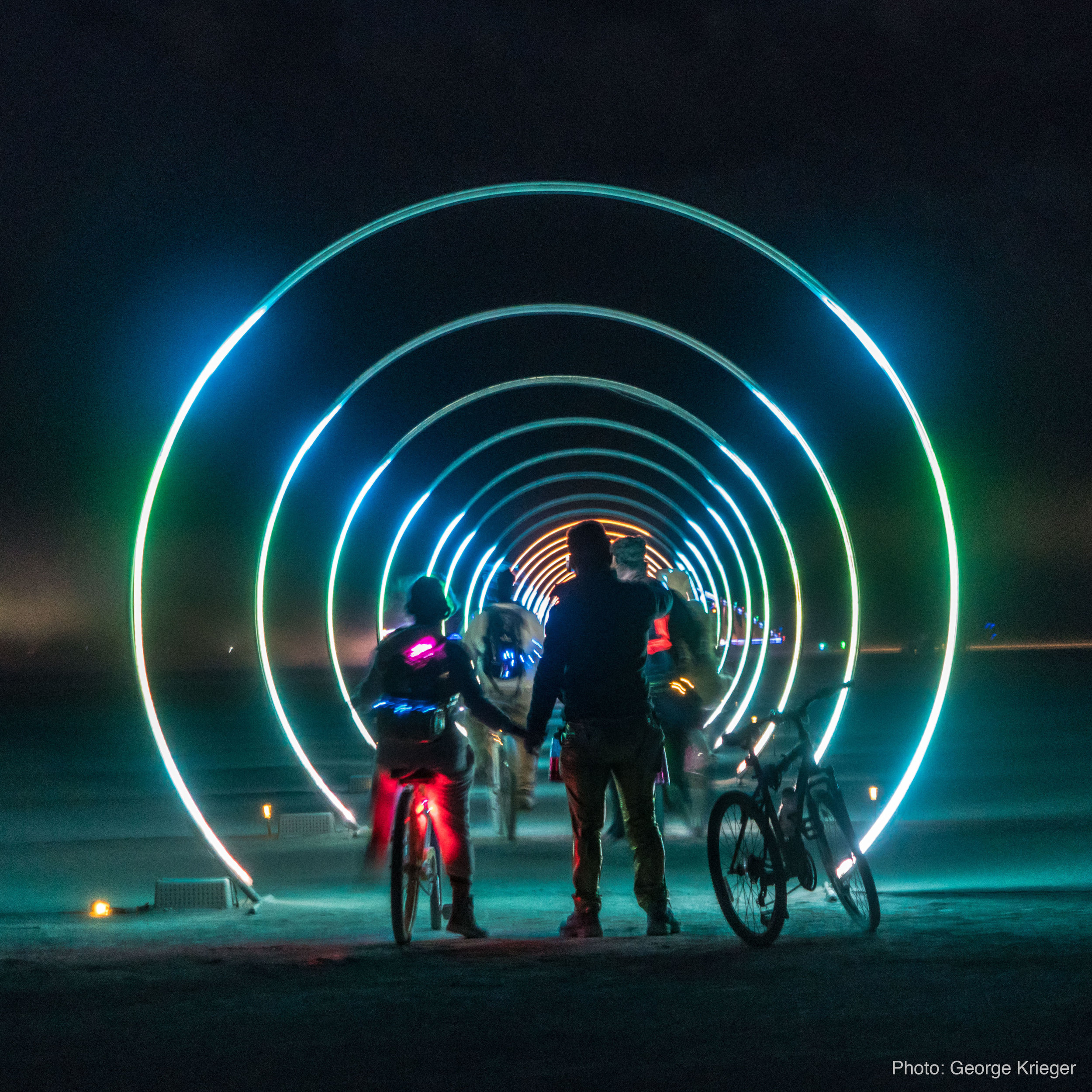
Sonic Runway — photo by George Krieger
Burning Man is an annual gathering that takes place in the middle of a vast desert in Nevada. For its 30th edition, about 70,000 people attended the festival this year.

Sonic Runway — photo by Jareb Mechaber
The idea behind Sonic Runway is to visualise the speed of sound by building a 300 meter (1000 feet) long corridor, materialized by 32 gates of colored lights.
Each of the gates would illuminate at the exact moment the sound, emitted from one end of the runway, reaches them.
The light patterns were created on the fly, using aubio to analyze the sound in real time and have the LED lights flash in sync with the music.
To cover the significant cost of hardware, the whole installation was funded by dozens of backers in a successful crowd-funding campaign.
Thu, 29 Dec 2016, 14:45. trackback - view/add comments
© 2003-2017 the aubio team | cc-by-sa